NEWYou can now listen to Fox News articles!
The Supreme Court struggled for consensus Tuesday as it publicly debated state bans on transgender female students from competing in women’s and girls’ scholastic sports.
Both sides repeatedly invoked contrasting versions of “fairness” and “equal opportunity” before the justices during a more than three-hour oral argument session in the courtroom.
Idaho and West Virginia separately defended their laws that limit participation for transgender females who were designated male at birth in both public school and college athletics.
They are among almost 30 states who say their restrictions are a matter of ensuring a level playing field and student safety.
HOUSE GOP LEADER BLASTS TRANS ATHLETES IN GIRLS’ SPORTS AS ‘BIGGEST FORM OF BULLYING’
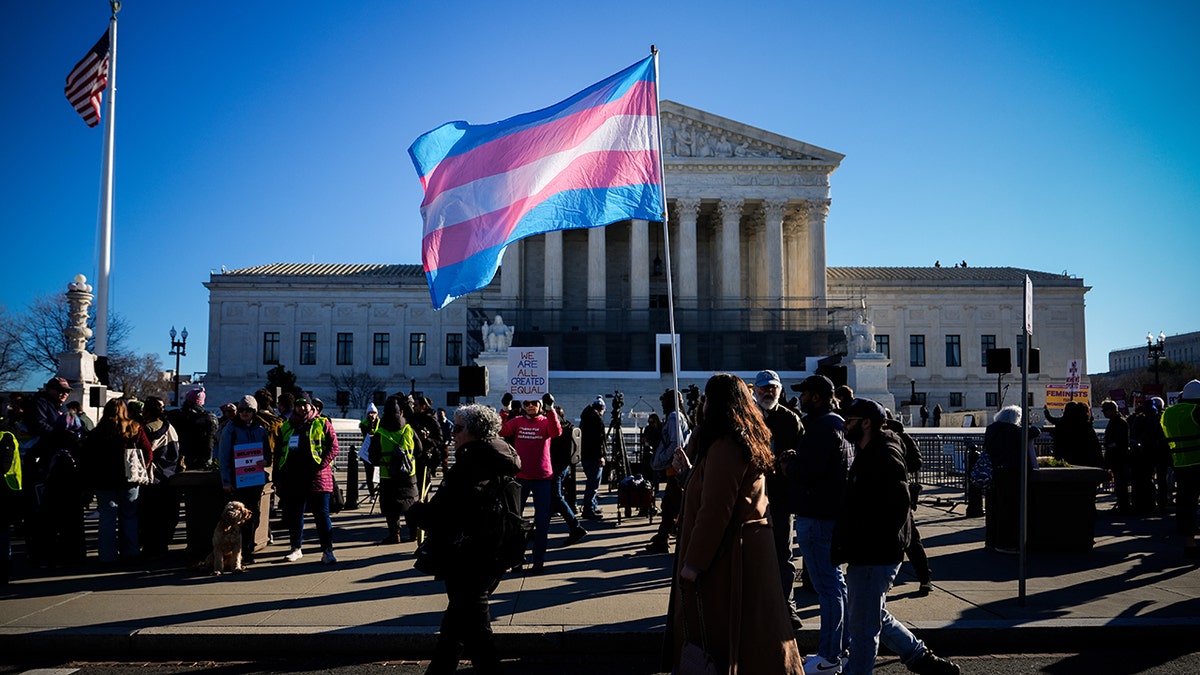
A protester carries a transgender pride flag outside the Supreme Court as it hears arguments over state laws barring transgender girls and women from playing on school athletic teams Tuesday, Jan. 13, 2026, in Washington. (Julia Demaree Nikhinson/AP)
But lawyers for a high school sophomore and a college senior counter that those prohibitions are clearly discriminatory and that the issues should be about equality and dignity for every student, free from politics and misinformation.
The high court is examining whether the laws violate the Constitution’s equal protection clause and the landmark federal law Title IX that prohibits sex discrimination in education.
A majority of the court — at least five of the six conservatives — appeared ready to back the state restrictions in some form. Only Justice Neil Gorsuch seemed open to some of the arguments by the student plaintiffs.
In arguments, much of the discussion came down to whether the transgender student population was large enough to give them an opportunity to defend their rights as a protected class.
With an estimated 2.8 million people in the U.S. who identify as transgender, Justice Sonia Sotomayor said their rights should be respected, even if they represent a relatively small percentage of the population.
“The numbers don’t talk about the human beings,” Sotomayor said.
“I’m struggling to understand how you can say that this law doesn’t classify on the basis of transgender status,” said Justice Ketanji Brown Jackson. “The law expressly aims to ensure that transgender women can’t play on women’s sports teams. So, why is that not a classification on the basis of transgender status?”
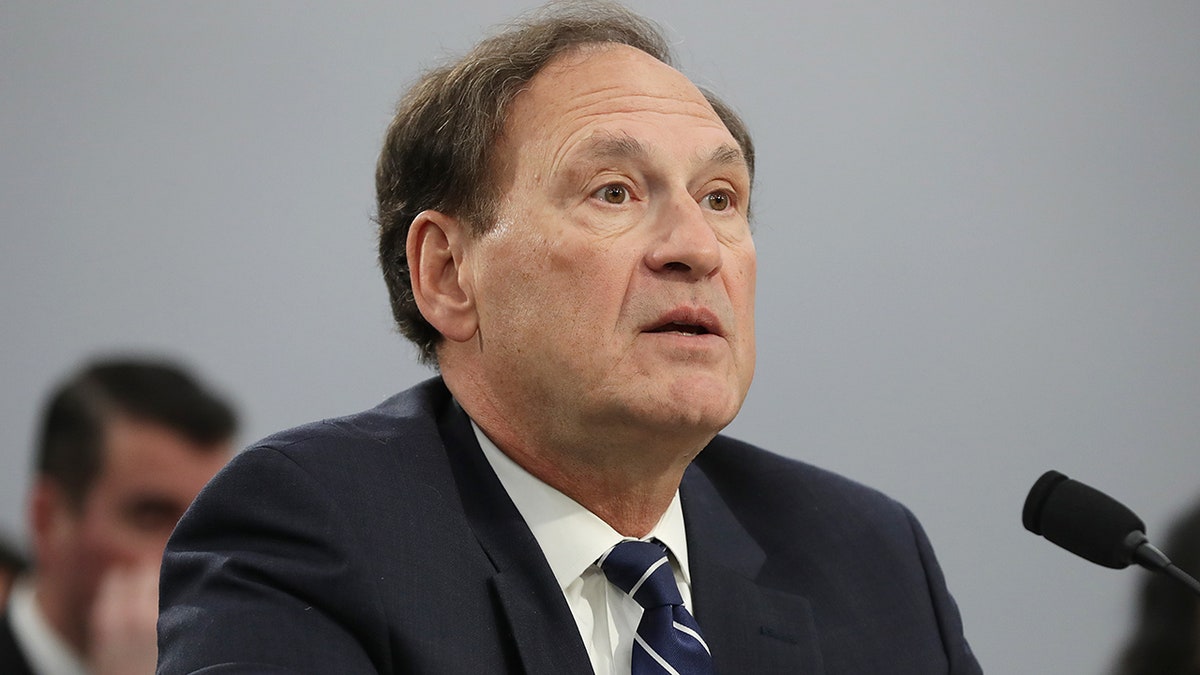
Supreme Court Associate Justice Samuel Alito testifies about the court’s budget during a hearing of the House Appropriations Committee’s Financial Services and General Government Subcommittee March 7, 2019, in Washington, D.C. (Chip Somodevilla/Getty Images)
But other members of the court suggested just the opposite.
“The question here is whether a sex-based classification is necessarily a transgender classification,” said Chief Justice John Roberts, skeptical of the position by lawyers for the student plaintiffs.
Roberts added that allowing exceptions for a relatively small subset of individuals could have larger implications.
“If we adopted that, that would have to apply across the board and not simply to the area of athletics,” he said.
The arguments also focused a great deal on the relative competitive advantages some transgender athletes would have competing in women’s sports.
Justice Samuel Alito said the reluctance of some female athletes to compete with and against transgender women is real.
“Looking to the broader issue that a lot of people are interested in, there are an awful lot of female athletes who are strongly opposed to participation by trans athletes in competitions with them,” said Alito. “What do you say about them? Are they bigots? Are they deluded in thinking they are subjected to unfair competition?”
“For the individual girl who does not make the team or doesn’t get on the stand for the medal or doesn’t make all-league, there’s a harm there,” said Justice Brett Kavanaugh, who for years coached his daughter’s basketball team. “And I think we can’t sweep that aside.”
He called the growing increase in female sports participation since Title IX was passed in 1972 “inspiring.”
Outside the courthouse, hundreds of activists groups on both sides rallied. Some carried signs like “protect women’s sports” and “trans rights are human rights.”
SUPREME COURT TO REVIEW STATE BANS ON TRANSGENDER ATHLETES’ PARTICIPATION IN SCHOOL SPORTS
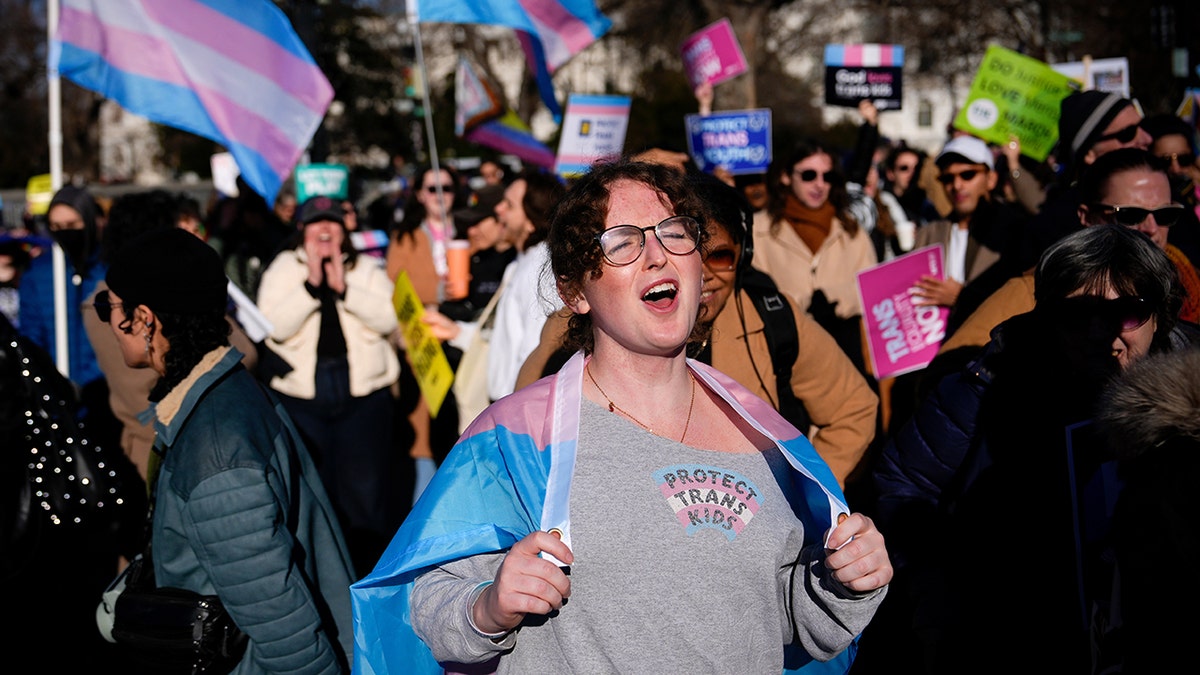
A protester with a transgender pride flag outside the Supreme Court as it hears arguments over state laws barring transgender athletes from playing on girls’ and women’s school athletic teams Tuesday, Jan. 13, 2026, in Washington (Julia Demaree Nikhinson/AP)
Inside, West Virginia plaintiff Becky Pepper-Jackson and her mother attended the oral arguments but did not speak.
This past year, Pepper-Jackson qualified for the West Virginia girls high school state track meet, finishing third in the discus throw and eighth in the shot put in the Class AAA division.
She has identified as female since third grade and has been taking puberty-blocking medication.
Although she is officially listed in court papers as B.P.J., her mother and ACLU lawyers have publicly identified her by Becky’s full name.
The Idaho plaintiff is Lindsay Hecox, a 24-year-old senior at Boise State University who wanted to compete on both NCAA-level and club sports teams for women.
Hecox now wants her high court case dismissed, fearing further harassment as she expects to graduate from college this spring. She says she will no longer play women’s sports in Idaho, but the justices will decide that question of mootness after argument.
Dozens of competing amicus, or supporting, legal briefs were filed by Republican- and Democratic-led states, Congress members, athletes, doctors, scientists and scholars.
The Trump administration was given argument time and said the federally-controlled Title IX does not apply to sex discrimination claims by transgender females.
Justice Department lawyer Hashim Mooppan suggested challenging a law on alleged sex-based discrimination requires a significant number of affected people to have it overturned.
“Why does it have to be that many people? Why? Why?” Justice Jackson asked, appearing exasperated.
Various hypotheticals were raised over how sex-based scholastic bans could apply beyond athletics, to science departments, chess clubs and remedial classes where brain chemistry and genetic differences have been debated.
“I think there are a lot of chess grandmasters who would tell you that women, for whatever reason, they’re not as good at this,” said Justice Elena Kagan.
President Donald Trump last February issued executive order 14201, “Keeping Men Out of Women’s Sports,” aimed at transgender athletes.
It is part of a broader federal effort to recognize what the White House says are “only two immutable sexes: male and female.”
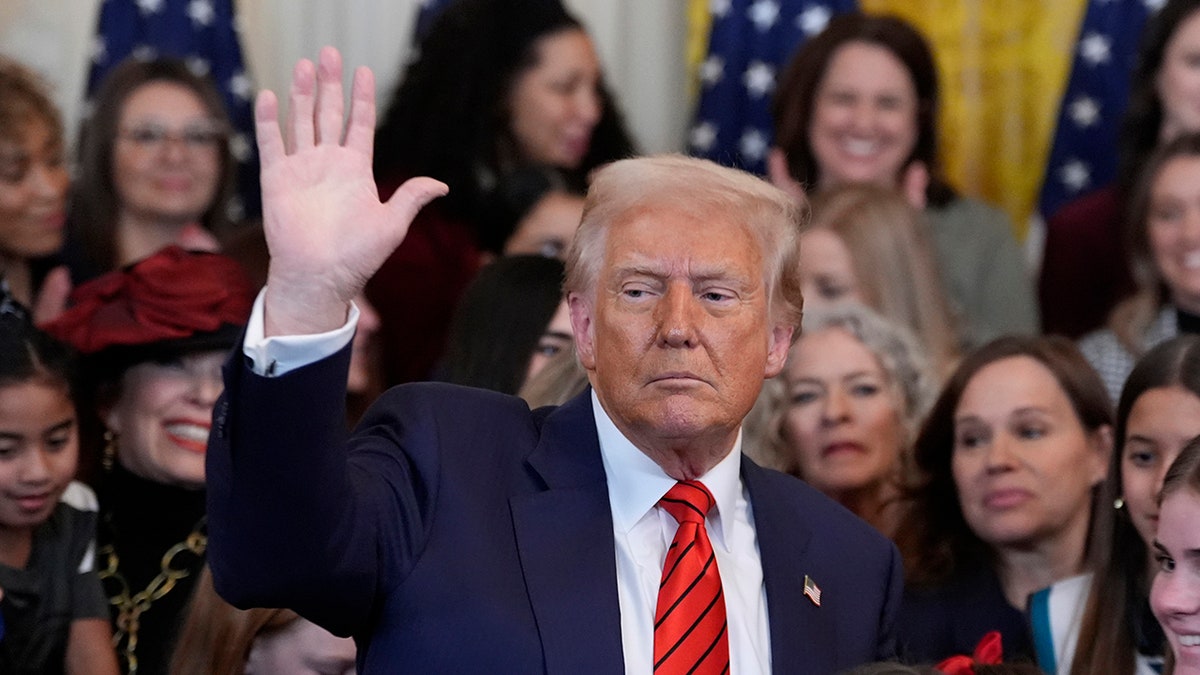
President Donald Trump waves after signing an executive order barring transgender female athletes from competing in women’s or girls’ sporting events, in the East Room of the White House Feb. 5, 2025, in Washington. (AP Photo/Alex Brandon)
What the court does here could affect other legal fights over LGBTQ+ rights, including transgender people having access to bathrooms or sex designation on documents like passports and driver’s licenses.
The justices have complete discretion to rule narrowly on the rights of athletic competitors or offer a more sweeping precedent on discrimination claims in the workplace, public spaces, military service, government benefits, housing, health care and education.
The Supreme Court in 2020 ruled workplace discrimination against transgender people amounts to sex discrimination.
But in June, the conservative court did not extend that protection to state bans on transgender minors seeking certain healthcare treatments.
The justices there said the issue was grounded on the basis of age and medical care, not sex or transgender status.
That legal articulation may now guide the high court in the current disputes, with questions from the bench Tuesday suggesting some justices may seek a cautious, limited approach to resolving this specific issue.
That could keep the courts out of the controversy for now.
CLICK HERE TO DOWNLOAD THE FOX NEWS APP
“Given that half the states are allowing it, allowing transgender girls and women to participate, about half are not,” Kavanaugh said. “Why would we, at this point, just the role of this court, jump in and try to constitutionalize a rule for the whole country while there’s still, as you say, uncertainty and debate.”
Such a ruling against the students would likely throw the issue back to the states, with the current mix of differing laws continuing to play out in the political process.
The high court cases are Little v. Hecox (24-38) from Idaho; and West Virginia v. B.P.J. (24-83). Decisions are expected by early summer.