NEWYou can now listen to Fox News articles!
The Supreme Court on Wednesday limited the scope of a key Voting Rights Act provision that restricts how states draw districts affecting minority voters, constraining states’ use of race as a factor when drawing congressional maps ahead of the 2026 midterms.
The 6-3 ruling narrows how states can consider race when drawing maps, a shift that could affect minority representation in multiple states and trigger a new wave of legal challenges over congressional boundaries.
The decision maintains the current legal standard for redistricting disputes nationwide, likely sustaining existing maps in several states and shaping how future challenges unfold in federal courts.
The case, Louisiana v. Callais, was first argued last March before the Supreme Court, and centered on whether Louisiana’s 2024 congressional map, which had added a second majority-Black district, amounted to an unconstitutional racial gerrymander.
The dispute reached the high court after months of legal back-and-forth, including oral arguments last March, and a rare second round of arguments last October, focused on whether Louisiana’s map (and creation of the second majority-Black district under the VRA) violated the 14th or 15th Amendments of the Constitution.
Conservative justices appeared skeptical during October’s arguments about keeping Section 2 of the VRA in place, as-is, and pressed the lawyer for the NAACP on whether she believed there should be a time duration limit on the intentional use of race in drawing voting districts under the law.
JUDGES SAY THEY’LL REDRAW LOUISIANA CONGRESSIONAL MAP THEMSELVES IF LAWMAKERS CAN’T
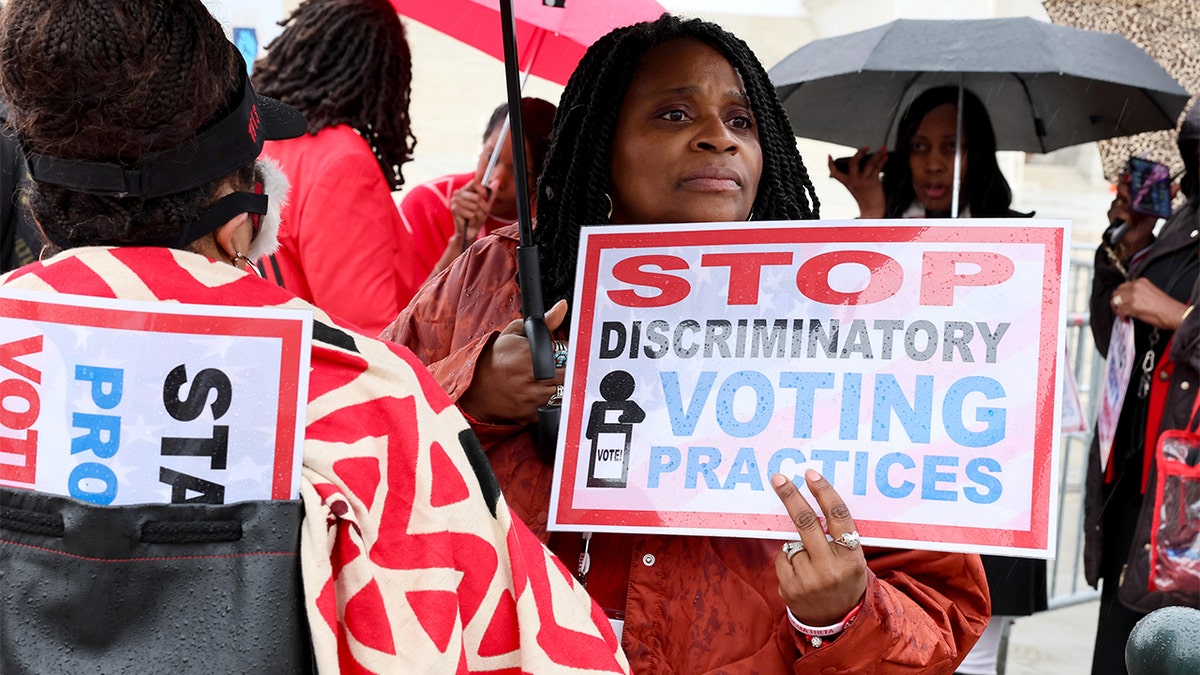
Black Louisiana voters and civil rights advocates call on SCOTUS to uphold a fair and representative congressional map in Louisiana v. Callais at the Supreme Court of the United States on Mar. 24, 2025 in Washington, D.C. (Jemal Countess/Getty Images for Legal Defense Fund)
During those arguments, Justice Brett Kavanaugh and other conservatives on the high court appeared open to the idea that Congress, in passing the 1965 Voting Rights Act law, may have intended a sort of “sunset period” for Section 2, allowing it to weaken over time.
That possibility was invoked by Kavanaugh several times during oral arguments, as he pressed lawyers for the state of Louisiana and the NAACP for more specifics.
Hashim Mooppan, the principal deputy solicitor general, told the court the congressional map in Louisiana that was drafted in response to Section 2 of the VRA could also be construed as a “reverse partisan gerrymander,” and one that is also based on “purely racial” considerations.
Meanwhile, NAACP lawyer Janai Nelson, arguing the case on behalf of Black voters, told the high court that siding with Louisiana’s request to reverse the map would be a “staggering reversal of precedent,” which she said “would throw maps across the country into chaos.”
NEW MAJORITY-BLACK LOUISIANA HOUSE DISTRICT REJECTED, NOVEMBER ELECTION MAP STILL UNCERTAIN
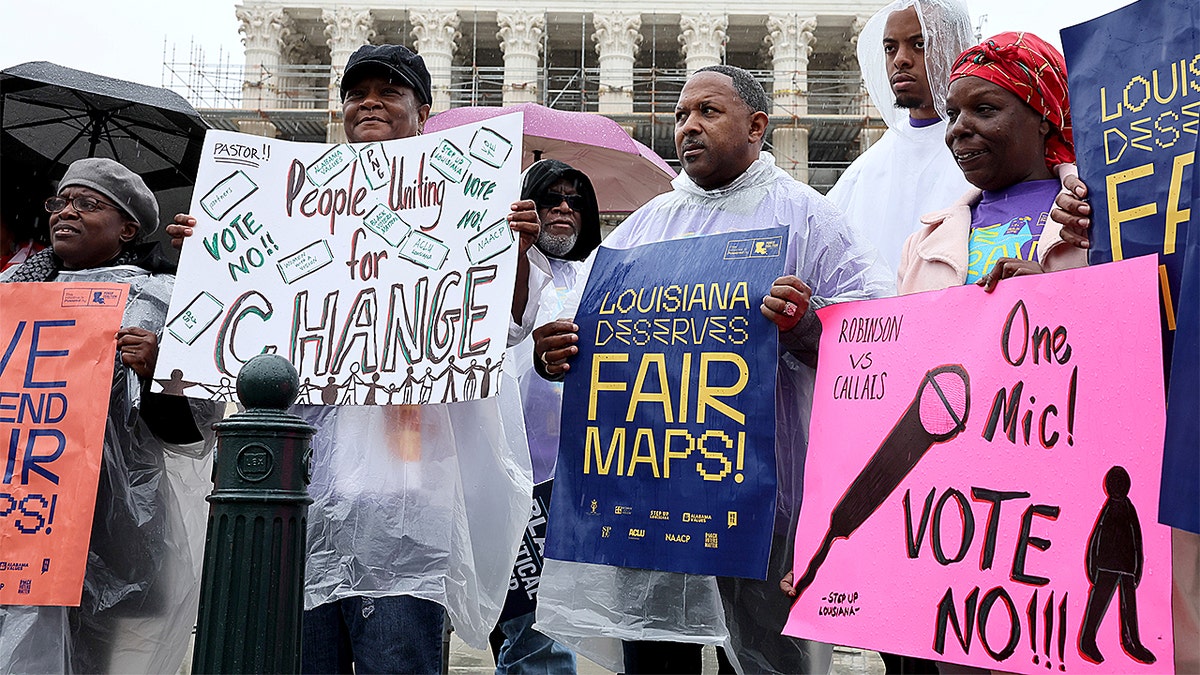
Black Louisiana voters and civil rights advocates call on SCOTUS to uphold a fair and representative congressional map in Louisiana v. Callais at the Supreme Court of the United States on Mar. 24, 2025, in Washington, D.C. (Jemal Countess/Getty Images for Legal Defense Fund)
A ruling from the high court has long been expected to have major implications for future elections.
Critics have warned in recent months that weakening VRA could further erode protections for minority voters under the Voting Rights Act, at a time when several Republican-led states have attempted to aggressively push through new congressional maps ahead of the midterms.
They argued in filings to the Supreme Court that non-Black voters failed to show the direct harm required for equal protection claims or prove race was the main factor in redrawing the map.
But lawyers arguing the case on behalf of the NAACP and Black voters in the state have warned that a ruling in favor of Louisiana could have a staggering impact on races in 2026 and beyond.
CLICK HERE TO GET THE FOX NEWS APP
A recent report from the nonprofit groups Fair Fight Action and Black Voters Matter Fund estimates that an overhaul of the VRA could swing an estimated 12 Democratic-held House districts in favor of Republican candidates.
This is a breaking news story. Check back shortly for updates.