NEWYou can now listen to Fox News articles!
Joint Russian and Chinese military aircraft and vessels have entered the U.S. Arctic air defense identification zone (ADIZ) near Alaska dozens of times in recent months, Sen. Dan Sullivan said in an interview with Fox News Digital, warning the activity amounts to coordinated pressure on America’s northern defenses.
Sullivan, R-Alaska, said data compiled by his office shows mostly airborne incursions — and at times joint patrols — along with several naval and “research” vessels operating inside the ADIZ, a buffer zone where aircraft must identify themselves but are not automatically denied access.
“They were spying on us,” Sullivan said, arguing the missions amount to strategic surveillance and have accelerated efforts to reopen the Navy base at Adak and expand Arctic infrastructure.
Sullivan led a Senate Commerce subcommittee hearing last month that secured $25 billion in new Coast Guard funding, including $4.5 billion for infrastructure upgrades such as a deepwater port in Nome — one of the closest U.S. cities to Russia — and additional Arctic icebreakers. The U.S. currently operates two icebreakers, one of which is out of service, compared with Russia’s reported 54.
RUSSIA, CHINA SQUEEZE US ARCTIC DEFENSE ZONE AS TRUMP EYES GREENLAND
Among the projects is a plan to reopen the military base on Adak Island near the end of the Aleutian chain, roughly 6,000 miles from Washington but on Russia’s doorstep.
Adak played a key role during World War II, when Japanese forces attacked parts of the Aleutians, and it later served as a Cold War outpost monitoring Soviet activity in the North Pacific.
“We have Adak Navy Base being reopened. We have this strategic deepwater port of Nome that’s finally being built [where] every essential Navy or Coast Guard asset with the exception of an aircraft carrier can port, and the icebreaker Storis being homeported in Juneau. There’s a lot going on,” Sullivan said. “We’re continuing to press it, and you know what I like to do with all the military services is press, press, press, press.”
TRUMP SAYS GREENLAND’S DEFENSE IS ‘TWO DOG SLEDS’ AS HE PUSHES FOR US ACQUISITION OF TERRITORY
Adak also hosts a 20-million-gallon fuel repository, Sullivan said, adding that revitalizing the compound would give U.S. destroyers and other vessels a crucial waypoint as malign activity heats up.
Sullivan said the incursions should concern all Americans, dismissing any suggestion the vessels were conducting benign research or trying to “save the whales.”
“They were there spying on us and looking at submarine routes, looking at cables,” he said, pointing to trans-Pacific communication lines that pass through Alaska. “That’s really, really strategic.”
He added that joint Russian-Chinese naval task forces operating in the U.S. ADIZ — alongside coordinated bomber patrols with armed fighters — is “unprecedented” in American territory.
NATO AMBASSADOR SAYS EUROPE ‘HAS A TENDENCY TO OVERREACT’ OVER GREENLAND DISPUTE
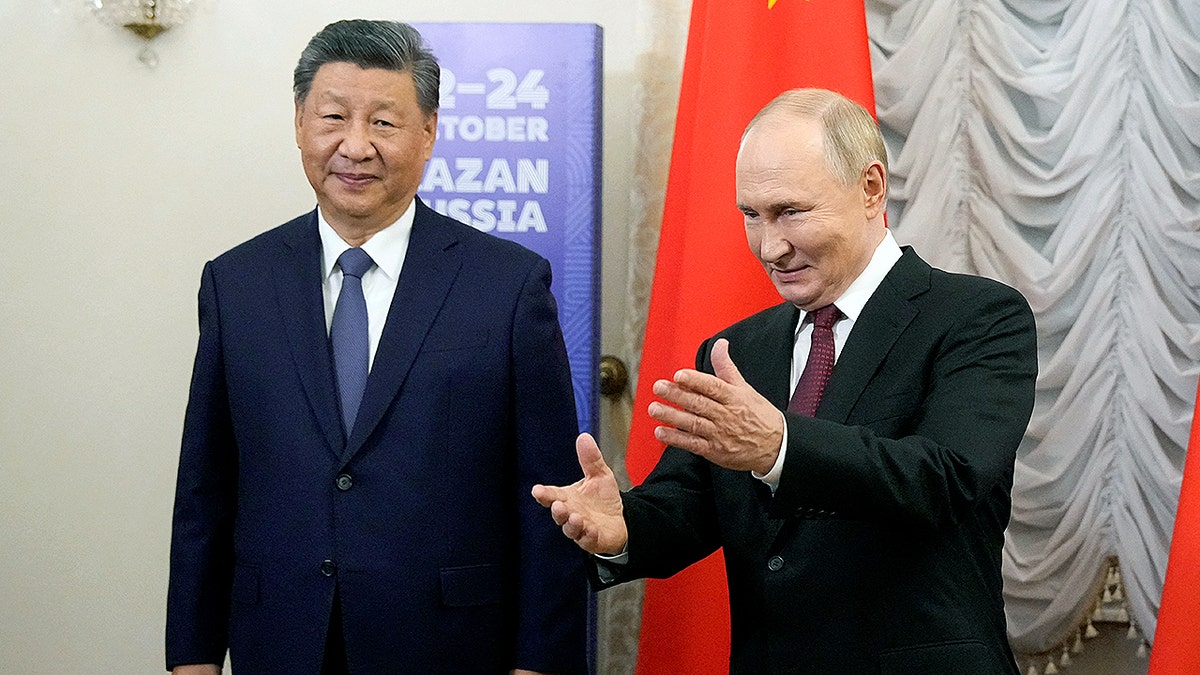
Chinese leader Xi Jinping and Russian leader Vladimir Putin meet in Kazan, Russia. (Reuters/Alexander Zemlianichenko)
When incursions occur, U.S. aircraft are dispatched from bases as far as 1,000 miles away, including Eielson Air Force Base near Fairbanks, a logistical stretch similar to sending New York City responders to a fire in Chicago.
The Nome port, Adak base and other new infrastructure will slash response times, increase defensive presence and keep America safer, he said.
“We are the Arctic part of America, but we’re America. And when our adversaries are pressing into us, we need to respond with force and infrastructure and capabilities. Our military’s doing it. We’re building that up with the Coast Guard, with the Air Force, with the Army,” he said.
TRUMP EYES ACTION ON GREENLAND, SETTING UP WHITE HOUSE FACE-OFF WITH DENMARK

Anchorage and the Chugach Range. (Zihao Chen/Getty Images)
A recent report from The Wall Street Journal detailing a Chinese vessel that transited the Bering Strait, icebreaking along Russia’s Arctic coast before docking in Poland, as further evidence of Beijing’s expanding Arctic reach.
Sullivan called the merchant vessel’s junket a prime example of why action is needed now to bolster America’s Arctic.
USAF Gen. Alexus Grynkewich — NATO’s top military official — told The Wall Street Journal the alliance sees China “being more and more aggressive” across the Arctic.
“It’s our territory, right? And we just need to be ready to defend it and have assets that can monitor whether that’s a merchant ship or a spy ship,” Sullivan added.
“The good news is with the Trump administration, with the Budget Reconciliation Bill, the Working Families Tax Cuts Act, and you saw the president before, and he wants a top line number for our military of about $1.5 trillion, that’s sending a message to China, Russia and all of our adversaries that we’re not going to let incursions into our airspace and our waters happen on a regular basis without forceful responses from the U.S. military.”
Sullivan said another development is expanding capacity at Point Barrow — at the “top of North America” — which, along with Adak, would allow the U.S. to intercept malign aircraft more quickly.
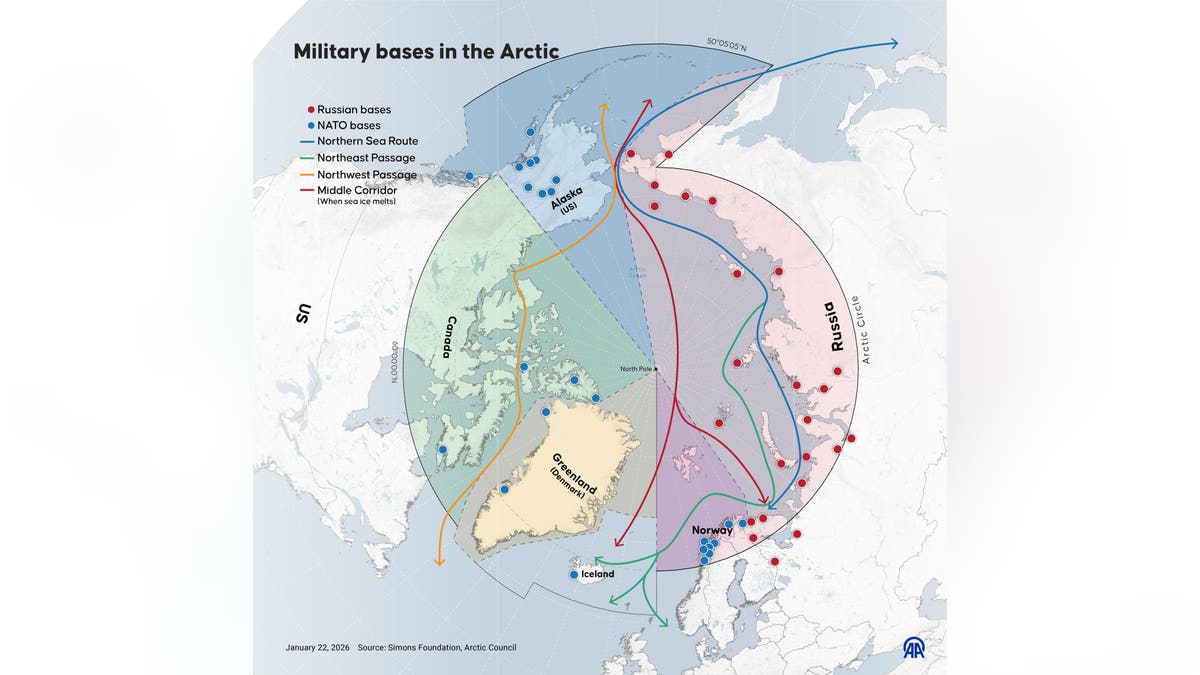
A map provided by Getty Images shows the various Arctic military bases. (Getty Images)
CLICK HERE TO DOWNLOAD THE FOX NEWS APP
The dynamic is also shaping global geopolitics, he said, as NATO shifts toward an “Arctic-capable alliance” — with allies Finland, Sweden and Norway similarly cognizant of the threats. Finland and Sweden recently joined NATO, he noted, which has been key to this situation.
Looking at the globe from above — rather than straight on — places the U.S., Canada and Scandinavia directly across from Russia and, increasingly, China, which has declared itself a “Near-Arctic power.”
Fox News Digital’s Kiera McDonald contributed to this report.